
Heads-up No Limit Hold’em is often considered the purest form of poker.
It tests every important skill at once: theoretical understanding, adaptability, decision-making under pressure, and mental resilience. At its core, HU poker is a duel with constantly shifting dynamics, where the ability to correctly interpret what’s happening at the table and adjust in real time largely determines success.
Undoubtedly, becoming a solid heads-up player requires serious work. It’s one of the most demanding formats and far from the easiest to learn. So a natural question arises: why invest time in such a challenging game when many simpler formats are available?
The short answer is that you will encounter head-up situations more often than you might expect — and being prepared pays off.
Why Heads-Up Skills Matter
For tournament players, the importance of heads-up poker is obvious. Unless a tournament ends in a rare three-way all-in, the final victory is decided heads-up. Stack depths may vary, but knowing how to perform well in a one-on-one scenario is extremely valuable.
Ultimately, beating the final opponent means securing the biggest pay jump and the first-place prize.
Cash game players also benefit from strong HU fundamentals. Sometimes you need to start a new table, and being able to avoid bleeding chips until more players join has a direct impact on your win rate.
Additionally, toward the end of a session, tables often break down naturally, and you may find yourself playing heads-up against an opponent you’d gladly continue battling. That’s when solid HU skills really matter.
Heads-up knowledge is essential for Spin & Go players as well, where each session consists of dozens of one-on-one matches.
Finally, there are still occasional opportunities to play dedicated heads-up games — being ready to take advantage of them will pay off.
What Makes Heads-Up Poker Unique?
The most crucial structural difference in heads-up play is range width. Ranges become dramatically wider compared to full-ring or 6-max games.
In most multiway formats, it’s correct to fold a large portion of weak, offsuit, and disconnected hands — both preflop and versus aggression. Heads-up, this logic no longer applies. In many situations, you’ll be putting money into the pot with up to 80% of all possible starting hands.
Playing so many hands is a direct result of positional dynamics. In heads-up poker, you are in either the Small Blind or the Big Blind every single hand, meaning that every preflop fold directly benefits your opponent. If you adopt an overly passive strategy, a competent opponent will quickly exploit you by picking up uncontested pots again and again.
Beyond strategy, the pace of heads-up poker places heavy demands on mental resilience. In a standard 6-max game — online or live — you can reset emotionally by folding a few hands or sitting out briefly. During heads-up, there is no such luxury.
When there’s only you and your opponent, the action never stops. You must remain focused and emotionally stable at all times. There is nowhere to hide from your opponent, and letting frustration from a lost pot or failed bluff influence your decisions is a fast way to give up tons of EV.
On the other hand, this intensity works both ways. If you’re better prepared and maintain composure under pressure, you can capitalize heavily on your opponent’s mistakes. Each heads-up match involves hundreds of decisions, and every small edge compounds over time.
Although many of your heads-up opponents will be reasonably competent, the complexity of the format leaves plenty of room to build a significant edge. Even regulars who successfully beat cash games and tournaments often neglect their heads-up skills, which makes them vulnerable to well-prepared opponents when it matters most.
How Wide Do Ranges Get in Heads-Up Games?
To illustrate how much ranges expand, let’s compare optimal heads-up ranges with their 6-max equivalents.
Assume a 100 BB cash game and a standard raise-to-2.5 BB/fold strategy.
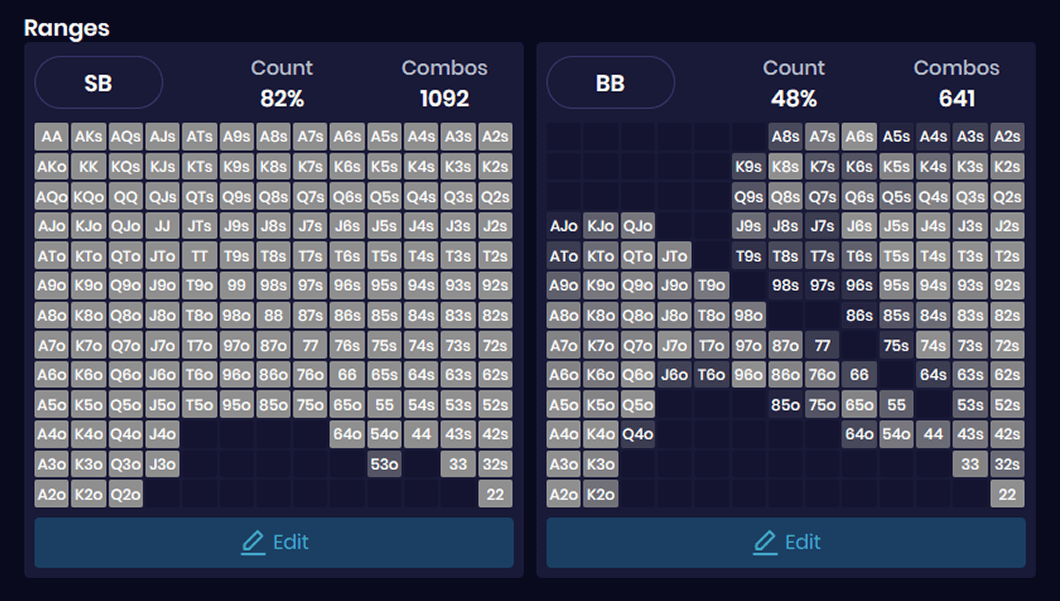
In a heads-up scenario, the Button (who is also the Small Blind) should open more than 80% of all hands. The Big Blind should defend around 48% by calling and 3-bet approximately 23% of the time. In total, the Big Blind defends over 70% of its range.
Now, let's compare this to a 6-max game.
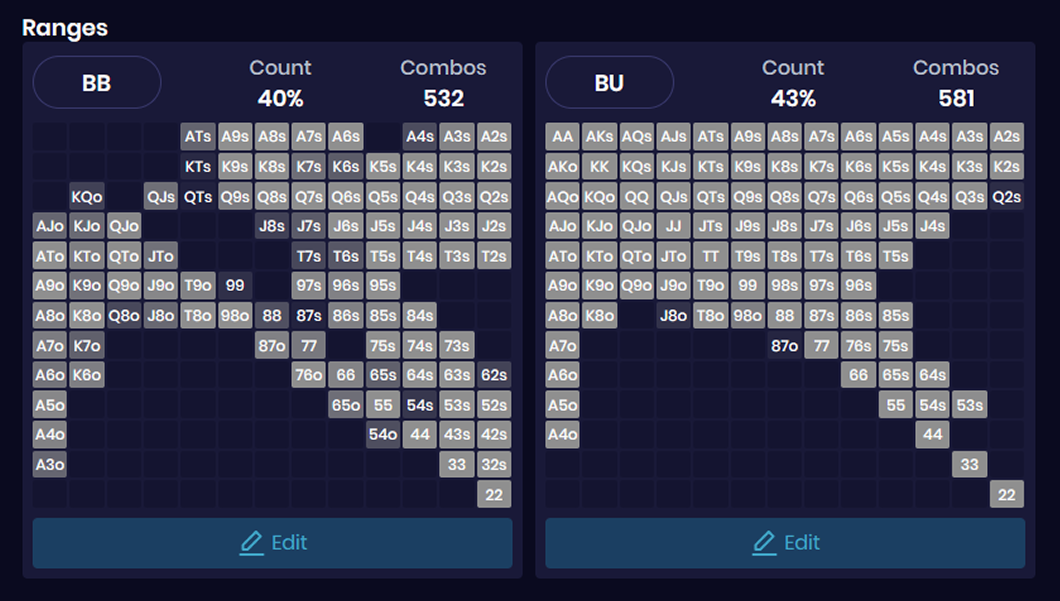
In this scenario the Button opens roughly 43% of hands. The Big Blind defends about 40% by calling and 13% by 3-betting, for a total defense frequency of around 53%.
The difference is substantial — heads-up poker forces both players to play significantly wider to avoid leaving money on the table. While you can simplify these ranges slightly for practical play, there’s a clear limit.
Becoming a competent HU player means learning how to handle hands that feel uncomfortable and unintuitive to many 6-max specialists — especially weak offsuit and poorly connected combinations.
Improving Your Heads-Up Game Makes You a Better Poker Player
Heads-up poker is not only a way to increase your earning potential; it’s also one of the best forms of poker practice. Every chip you win comes directly from your opponent, and every mistake is immediately punished. This dependence makes the format both demanding and highly rewarding.
Understanding how to navigate situations that other players struggle with is a major edge in poker. Studying and mastering heads-up spots — often overlooked or avoided by many regulars — puts you in a strong position across formats.
Poker solvers are particularly effective tools for developing HU skills. One-on-one scenarios are among the easiest to analyze accurately, as they involve fewer assumptions and no ICM considerations.
Tools like Deepsolver are designed precisely for this purpose, allowing you to build intuition and refine strategies in the exact situations that matter most in heads-up play.